
📷 Kredit: Dan Bartlett
Penjelasan
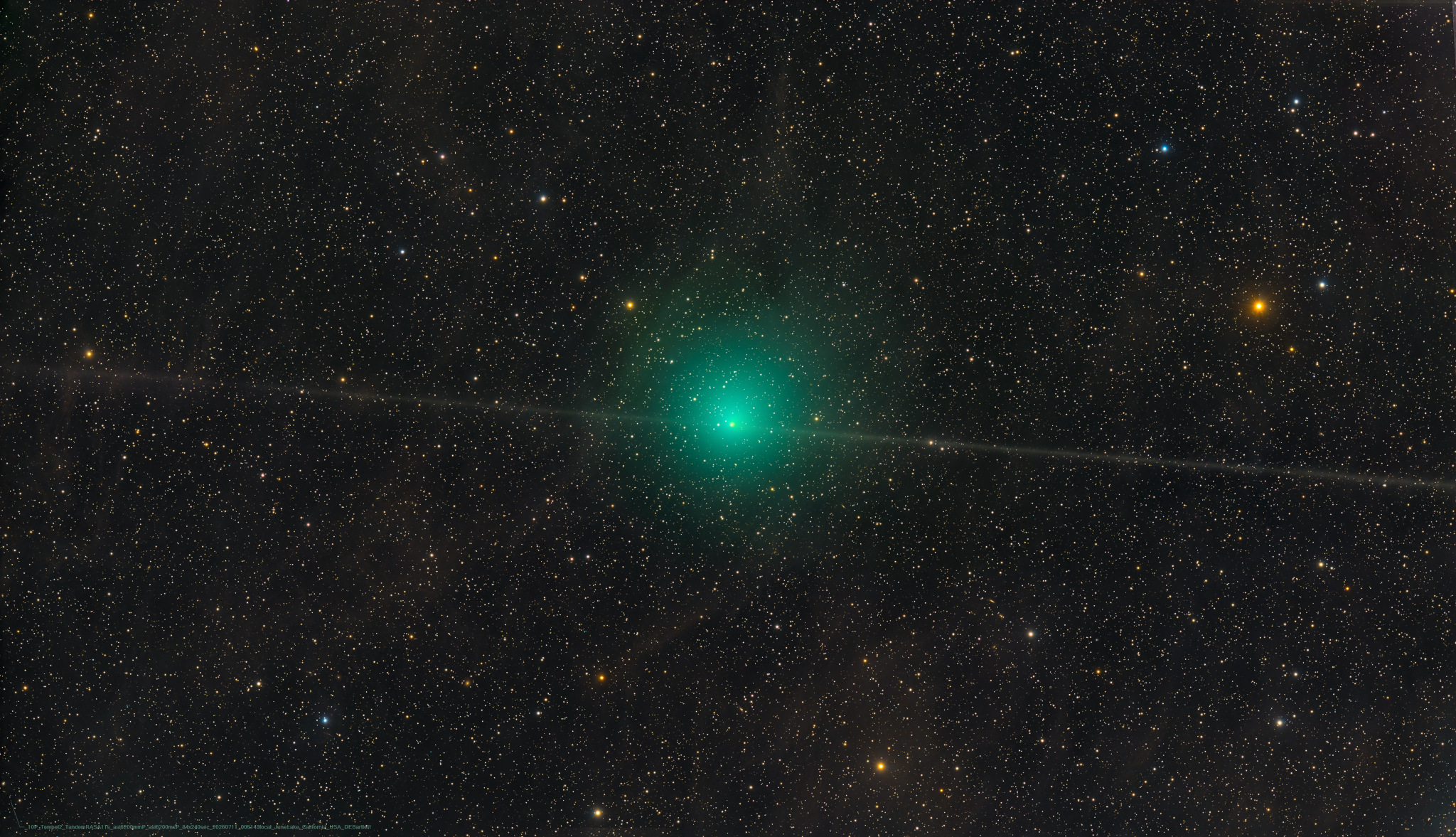
Komet 10P/Tempel 2 mengorbit Matahari sekali setiap 5,4 tahun. Saat ini terlihat dengan teropong atau teleskop kecil ke arah konstelasi Capricornus, komet periodik ini tertangkap dalam gambar teleskop yang tajam ini dari tanggal 11 Juli, menampilkan wilayah inti yang terang dan koma kehijauan yang indah. Yang luar biasa, jejak debu tipis, bukan ekor debu biasa, juga terlihat membentang ke timur dan barat inti Tempel 2. Tidak seperti ekor debu komet, yang cenderung menyebar sementara ke arah menjauh dari Matahari, jejak debu ini disebabkan oleh debu sisa yang dilepaskan selama banyak orbit masa lalu di sepanjang bidang orbit komet periodik kuno ini. Bahkan, jejak debu Tempel 2 mungkin akan sedikit lebih sempit dan lebih terang dari perspektif kita saat Bumi melintasi bidang orbit komet pada tanggal 20 Juli. Komet 10P/Tempel 2 akan mencapai perihelion pada tanggal 2 Agustus, dan akan berada paling dekat dengan Bumi pada tanggal 3 Agustus.
Sumber: NASA APOD | 2026-07-17
English: Comet 10P/Tempel 2 orbits the Sun once every 5.4 years. Currently visible in binoculars or small telescopes toward the constellation Capricornus, the periodic comet is captured in this sharp telescopic image from July 11 sporting a bright nuclear region and pretty greenish coma. Remarkably, a thin dust trail, not a typical dust tail, is also seen extending both east and west of the Tempel 2 nucleus. Unlike a comet dust tail, which tends to temporarily fan out in a direction away from the Sun, this dust trail is due to the residual dust shed during many past orbits along this ancient periodic comet's orbital plane. In fact, Tempel 2's dust trail may get a little narrower and brighter from our perspective as Earth crosses through the comet's orbital plane on July 20. Comet 10P/Tempel 2 will reach a perihelion on August 2, and make its closest approach to Earth on August 3.