
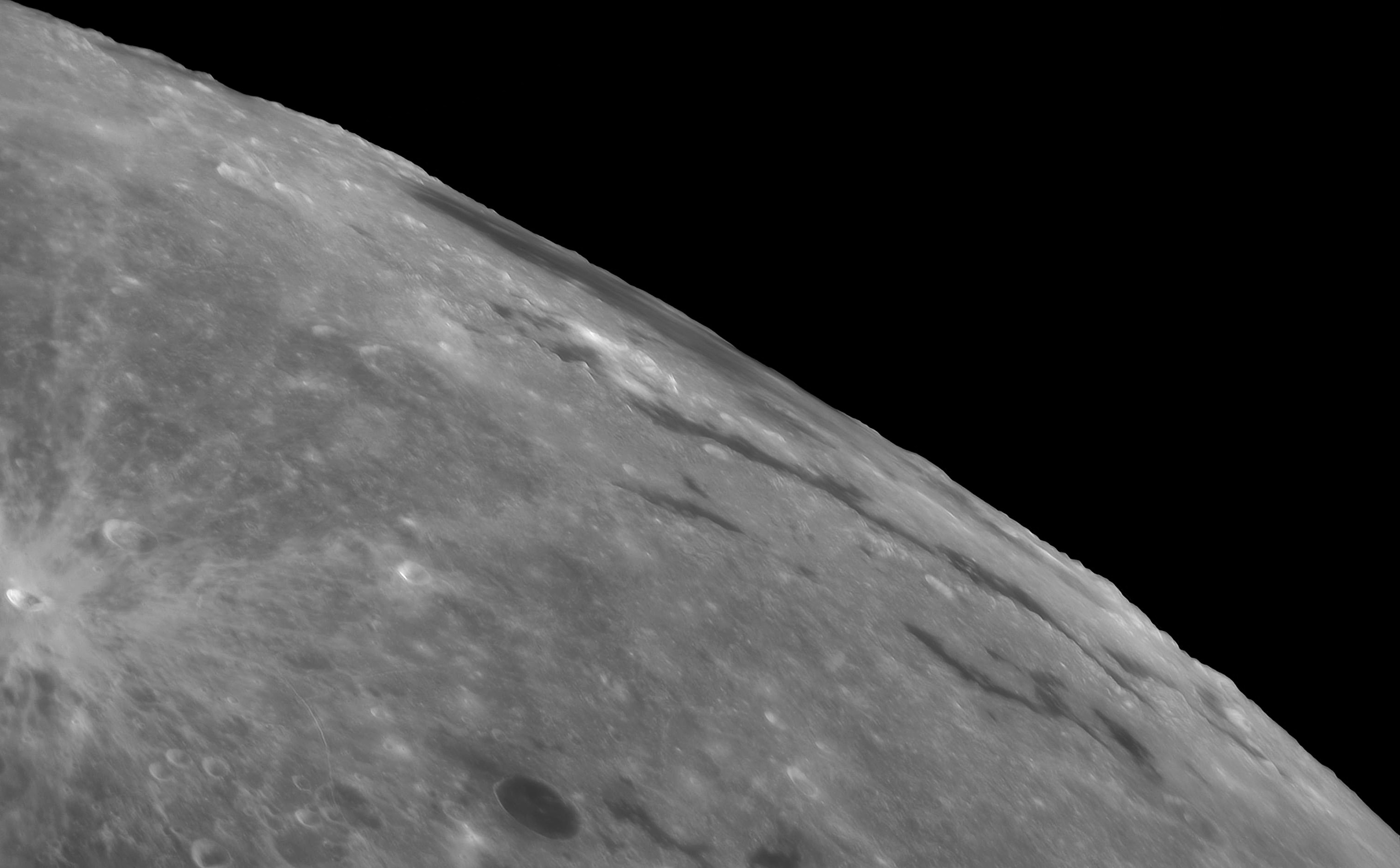
📷 Kredit: The Mare Orientale
Penjelasan
Mare Orientale, dalam bahasa Latin berarti Laut Timur, adalah salah satu fitur bulan berskala besar yang paling mencolok. Sebagai cekungan tumbukan bulan terbesar yang termuda, sangat sulit untuk dilihat dari perspektif Bumi. Namun, yang diabadikan pada tanggal 7 Juli selama periode kemiringan yang menguntungkan, atau librasi sisi dekat bulan, Laut Timur dapat ditemukan di kanan atas dalam pandangan teleskopik yang tajam ini. Dalam gambar tersebut, mare bulan yang besar tampak sangat terdistorsi dan membentang di sepanjang tepi barat Bulan. Terbentuk oleh tumbukan asteroid lebih dari 3 miliar tahun yang lalu dan berdiameter hampir 1000 kilometer, fitur melingkar konsentris cekungan tumbukan tersebut merupakan riak di kerak bulan. Tetapi fitur-fitur tersebut sedikit lebih mudah terlihat dalam gambar yang lebih langsung dari wilayah tersebut yang diambil dari orbit bulan. Jadi mengapa Laut Timur berada di tepi barat Bulan? Fitur bulan Mare Orientale dinamai sebelum tahun 1961. Saat itulah konvensi penamaan timur dan barat pada peta bulan dibalik.
Sumber: NASA APOD | 2026-07-10
English: The Mare Orientale, Latin for Eastern Sea, is one of the most striking large scale lunar features. The youngest of the large lunar impact basins it's very difficult to see from an earthbound perspective. Still, captured on July 7 during a period of favorable tilt, or libration of the lunar nearside, the Eastern Sea can be found at the upper right in this sharp telescopic view. In the image, the large lunar mare is extremely foreshortened and stretches along the Moon's western edge. Formed by the impact of an asteroid over 3 billion years ago and nearly 1000 kilometers across, the impact basin's concentric circular features are ripples in the lunar crust. But they are a little easier to spot in more direct images of the region taken from lunar orbit. So why is the Eastern Sea at the Moon's western edge? The Mare Orientale lunar feature was named before 1961. That's when the convention labeling east and west on lunar maps was reversed.