
📷 Kredit: Ángel Molina Text: Keighley Rockcliffe (NASA GSFC, UMBC CSST, CRESST II)
Penjelasan
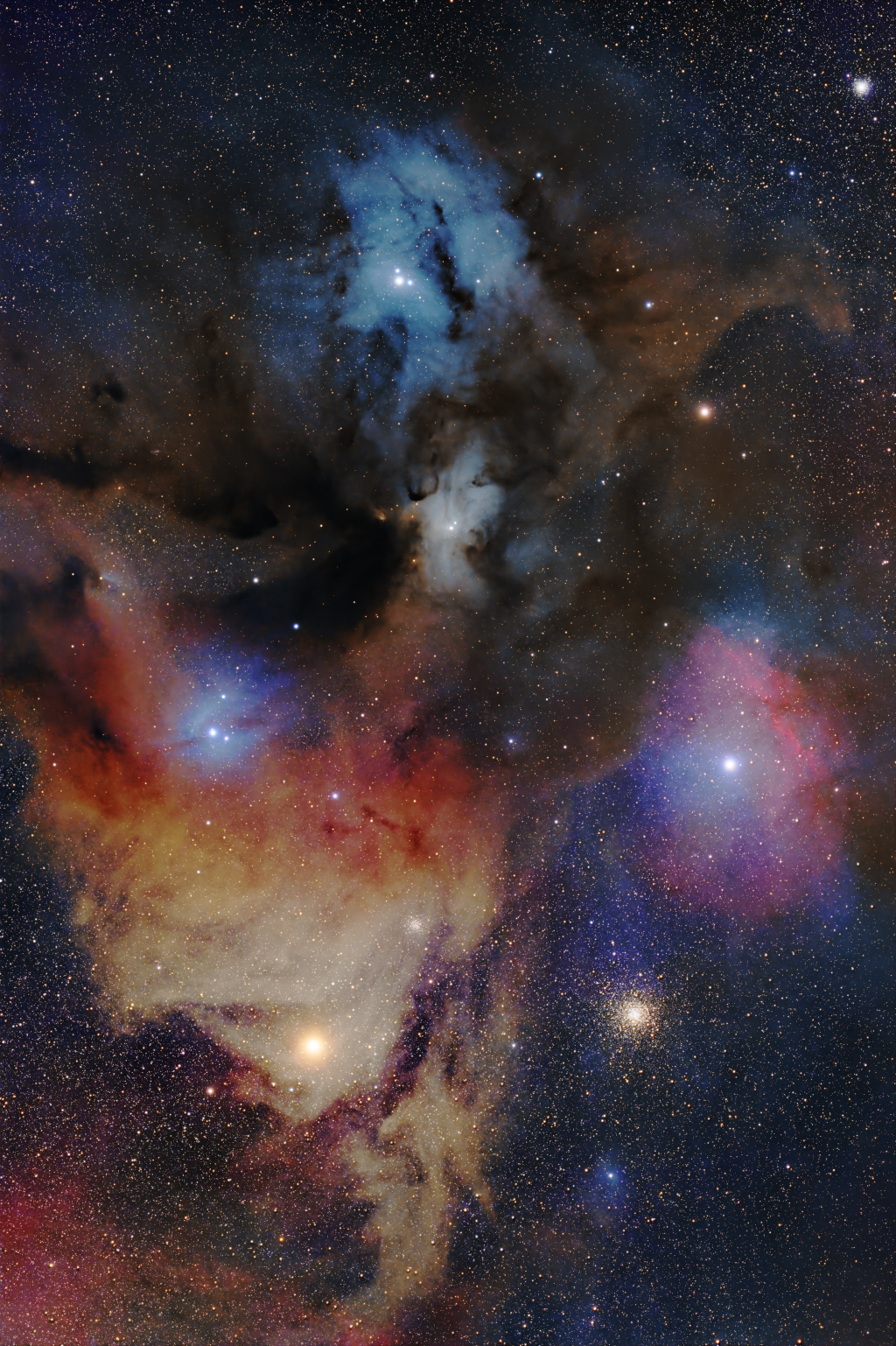
Meskipun terlihat seperti permen kapas, awan-awan ini tidak bisa dimakan! Diambil di Cádiz, Spanyol, gambar hari ini menampilkan kompleks Rho Ophiuchi, permadani kaya fenomena astronomi muda dan tua. Kompleks awan berwarna-warni ini adalah wilayah pembentukan bintang di dekatnya yang berisi ratusan objek bintang muda, termasuk protobintang dan bintang T Tauri. Cahaya dari sistem bintang rangkap tiga di pusatnya memantul dari butiran debu kecil untuk menciptakan nebula refleksi biru. Sinar ultraviolet dari bintang-bintang panas mengionisasi gas hidrogen di sekitarnya, menciptakan nebula emisi merah. Antares, sebuah superraksasa merah yang cukup besar untuk menelan sabuk asteroid Tata Surya, menerangi wilayah kuning. Debu antarbintang gelap menghalangi sebagian warna kompleks tersebut. Pengamatan JWST baru-baru ini menunjukkan bayangan yang dihasilkan oleh cakram sirkumstellar tersembunyi, tahap awal pembentukan planet. Messier 4, gugus bola yang hampir setua alam semesta, terletak di kanan bawah dan menyaksikan ledakan muda yang kacau lainnya di Bima Sakti.
Sumber: NASA APOD | 2026-07-01
English: Although they look like cotton candy, you cannot eat these clouds! Taken in Cádiz, Spain, today's image features the Rho Ophiuchi complex, a rich tapestry of young and old astronomical phenomena. This colorful cloud complex is a nearby star-forming region containing hundreds of young stellar objects, including protostars and T Tauri stars. Light from the triple star system at its center reflects off of small dust grains to create the blue reflection nebula. Ultraviolet light from hot stars ionizes the surrounding hydrogen gas, creating the red emission nebula. Antares, a red supergiant big enough to engulf the Solar System’s asteroid belt, lights up the yellow region. Dark interstellar dust blocks some of the complex’s color. Recent JWST observations exhibit shadows cast by hidden circumstellar disks, the beginning stages of planet formation. Messier 4, a globular cluster almost as old as the universe, sits in the bottom right and witnesses yet another chaotic burst of youth in the Milky Way.