
📷 Kredit: Josh Dury
Penjelasan
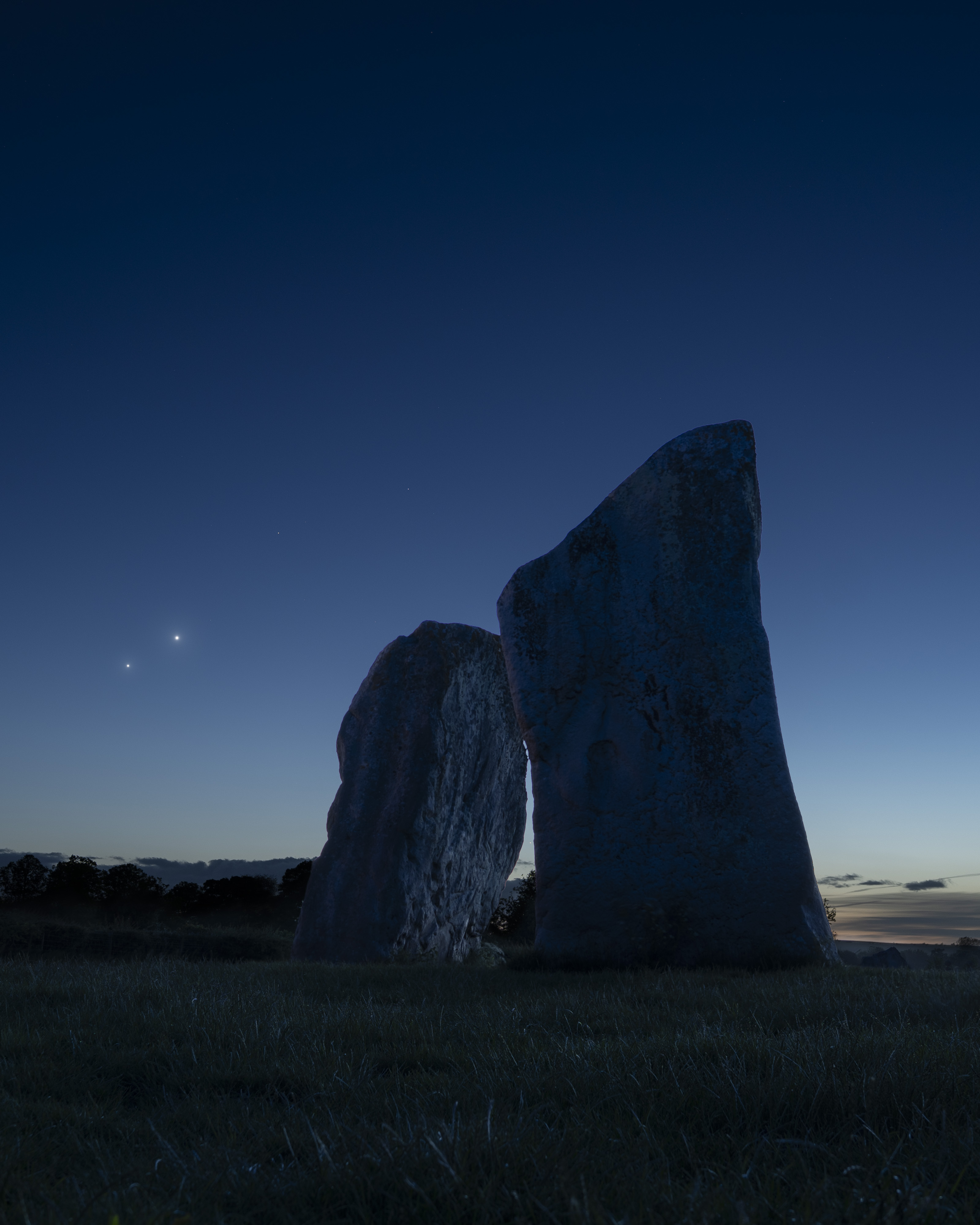
Untuk melihat Venus dan Jupiter bersama-sama bulan ini, Anda tidak memerlukan teropong atau bahkan teleskop. Cukup lihat ke atas setelah matahari terbenam dan Anda akan menemukan mereka muncul saat langit mulai gelap di dekat cakrawala barat. Bahkan, pada tanggal 9 Juni, kedua planet paling terang itu berada dalam konjungsi dekat, terpisah di langit kurang dari 2 derajat dari perspektif kita. Karena planet Venus (yang lebih terang) mengorbit Matahari lebih cepat daripada planet Jupiter (yang lebih besar), ia menyusul dan melewati planet Jupiter di sepanjang ekliptika kira-kira setiap 13 bulan. Tetapi setiap tiga tahun sekali, konjungsi yang dihasilkan dapat dilihat cukup jauh dari Matahari sehingga mudah terlihat di langit senja Bumi. Pada tanggal 9 Juni, "ciuman kosmik" dekat kedua benda langit ini diabadikan di sini, di samping dua batu besar yang berdiri di teluk di dalam lingkaran batu berusia 4.000 tahun di Avebury, Inggris. Lebih besar dari Stonehenge, kompleks lingkaran batu dan henge Avebury juga diakui sebagai salah satu situs upacara neolitik paling signifikan di planet Bumi.
Sumber: NASA APOD | 2026-06-12
English: To see Venus and Jupiter together this month, you won't need binoculars or even a telescope. Just look up after sunset and you'll find them emerging as the sky grows dark near the western horizon. In fact, on June 9 the two brightest planets were in close conjunction, separated on the sky by less than 2 degrees from our perspective. Since (brighter) inner planet Venus orbits the Sun faster than outer planet Jupiter, it catches up with and passes the outer planet along the ecliptic roughly every 13 months. But every three years or so their resulting conjunction can be viewed far enough from the Sun to be easily seen in Earth's twilight skies. On June 9, the two celestial beacon's close "cosmic kiss" was captured here next to the two large standing stones at the cove within a 4,000 year old stone circle at Avebury, UK. Larger than Stonehenge, the Avebury henge and stone circle complex is also recognized as one of the most significant neolithic ceremonial sites on planet Earth.