
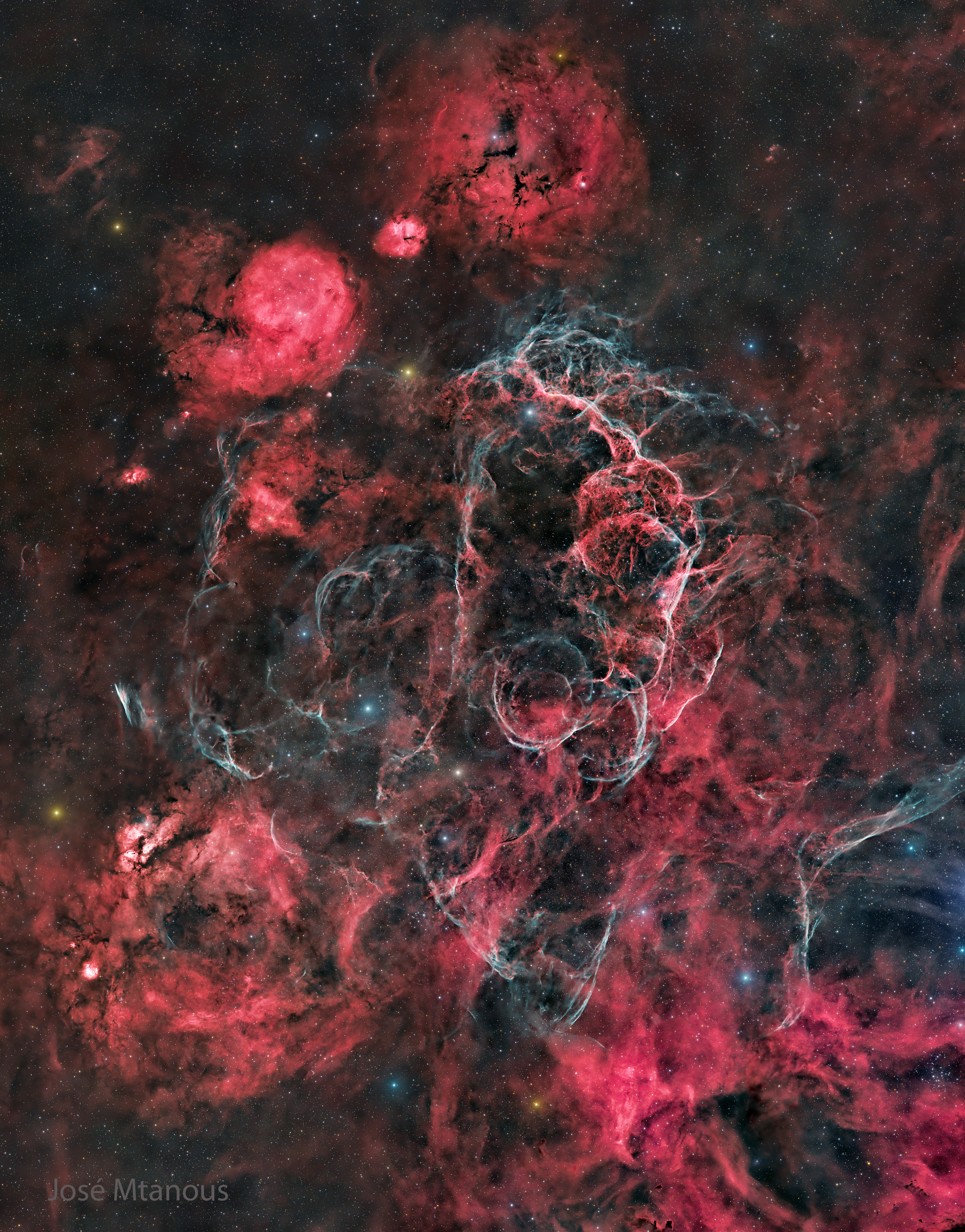
📷 Kredit: José Mtanous
Penjelasan
Ledakan telah berakhir, tetapi konsekuensinya masih berlanjut. Sekitar dua belas ribu tahun yang lalu, sebuah bintang yang relatif normal di konstelasi Vela tiba-tiba meledak, menciptakan titik cahaya aneh yang sempat terlihat oleh manusia yang hidup di dekat awal sejarah yang tercatat. Lapisan luar bintang tersebut menabrak medium antarbintang, menghasilkan gelombang kejut yang masih terlihat hingga saat ini. Gambar unggulan, yang diambil sedikit demi sedikit selama 60 jam dari Wilayah Khomas di Namibia, menangkap sebagian dari gelombang kejut yang berbentuk filamen dan raksasa itu dalam cahaya tampak, dengan detail yang disorot oleh emisi hidrogen (merah) dan oksigen (biru). Saat gas terbang menjauh dari bintang yang meledak, gas tersebut meluruh dan bereaksi dengan medium antarbintang, menghasilkan cahaya dalam berbagai warna dan pita energi. Yang tersisa di pusat Sisa Supernova Vela adalah pulsar, sebuah bintang yang sepadat materi nuklir yang berputar lebih dari sepuluh kali dalam satu detik. Jelajahi Alam Semesta: Generator APOD Acak
Sumber: NASA APOD | 2026-06-02
English: The explosion is over, but the consequences continue. About twelve thousand years ago, a relatively normal star in the constellation Vela suddenly exploded, creating a strange point of light briefly visible to humans living near the beginning of recorded history. The outer layers of the star crashed into the interstellar medium, driving a shock wave that is still visible today. The featured image, taken piecemeal over 60 hours from the Khomas Region of Namibia, captures some of that filamentary and gigantic shock in visible light, with details highlighted by hydrogen (red) and oxygen (blue) emissions. As gas flies away from the detonated star, it decays and reacts with the interstellar medium, producing light in many different colors and energy bands. Remaining at the center of the Vela Supernova Remnant is a pulsar, a star as dense as nuclear matter that spins around more than ten times in a single second. Explore the Universe: Random APOD Generator